How Do You Know When Tree Felling Has Become Necessary?
Trees can be an important part of a garden, providing structure, character, screening and seasonal interest. In many situations, pruning, crown reduction or other forms of tree surgery can keep an established tree manageable for many years. However, there are circumstances where retaining a particular tree may no longer be the most practical option and tree felling needs to be considered.
For property owners in Halesworth, Suffolk, deciding whether a tree should be felled requires more than judging its size or appearance. Its condition, structure, position and relationship with the surrounding property all need to be assessed. Professional tree surgery helps establish whether appropriate management can retain the tree or whether removal has become the more suitable solution.
Tree Felling Should Not Automatically Be the First Option
A large or overgrown tree does not necessarily need to be removed.
Many problems associated with established trees can be managed through appropriate tree surgery. Depending on the individual tree, this could involve:
- Crown reduction
- Selective pruning
- Crown lifting
- Removal of dead or damaged branches
- Ongoing management of excessive growth
Where the tree remains suitable for retention, these methods may resolve the immediate concern without removing it completely.
Tree felling becomes more relevant when pruning cannot adequately address the underlying problem or when the tree’s overall condition makes continued management increasingly unsuitable.
1. The Tree Has Experienced Significant Structural Damage
One reason tree felling may become necessary is substantial structural deterioration.
Trees rely on their trunks, major limbs and root systems working together to support a large and often very heavy crown. If an important structural component becomes seriously compromised, removing individual branches may not resolve the wider issue.
Warning signs can include:
- Significant splits within major limbs
- Large damaged sections
- Major branch failure
- Visible deterioration within the trunk
- Substantial changes in the tree’s structure
Not every visible defect means a tree requires removal, which is why professional assessment is important.
2. The Tree Is Dead or in Serious Decline
A dead tree no longer has the ability to produce healthy new growth or respond to changing conditions in the same way as a living tree.
As deterioration progresses, branches and other structural components may gradually weaken.
A tree in decline can be more difficult to assess because some sections may still appear healthy while others are deteriorating.
Signs that deserve professional attention include:
- Extensive dead branches
- Significant canopy dieback
- Reduced or abnormal foliage
- Sections failing to produce expected growth
- Widespread deterioration
The overall condition needs to be considered before deciding whether pruning remains worthwhile or removal is appropriate.
3. Major Branch Failure Has Changed the Tree’s Balance
Losing one large branch can significantly alter the structure of a mature tree.
The remaining crown may become uneven, or previously sheltered limbs may experience different forces after the loss of surrounding growth.
Professional tree surgeons can assess whether the remaining tree can be appropriately managed through pruning or whether the extent of structural change has made retention impractical.
The decision depends on which branch has failed, the condition of the remaining structure and the overall form of the tree.
4. The Tree Has Developed a Significant Lean
Some trees naturally grow at an angle and can remain stable for many years. A leaning tree therefore does not automatically require felling.
A change in the lean, however, can be more concerning.
Possible signs worth investigating include:
- A lean that appears to have developed recently
- Changes around the base of the tree
- Soil movement
- Exposed or disturbed roots
- Cracking in the surrounding ground
- A noticeable change following severe weather
These signs require careful assessment because the root system is fundamental to the tree’s stability.
5. The Root System Has Been Seriously Compromised
Much of a tree’s structural support is hidden below ground.
Root damage can therefore be particularly difficult for a homeowner to evaluate. Changes around the base of a tree, significant ground disturbance or other unusual signs may indicate that closer investigation is needed.
Tree surgery carried out within the crown cannot compensate for every significant problem affecting the root system.
Where the tree’s stability has become seriously compromised, felling may need to be considered.
6. The Tree Has Become Unsuitable for Its Location
Sometimes the issue is not that the tree is unhealthy, but that its mature size is no longer compatible with the space available.
A tree that was relatively small when originally planted can eventually become a dominant feature within a restricted garden.
Its canopy may begin interfering with:
- Buildings
- Garden structures
- Driveways
- Paths
- Other established trees
- Usable outdoor areas
In many cases, professional pruning can manage these conflicts. However, repeated substantial reductions may not always provide a sensible long-term solution for every tree.
A professional assessment can determine whether continued management is practical.
7. Repeated Pruning Is No Longer Solving the Problem
Regular tree surgery can successfully manage many mature trees. However, there can be situations where increasingly frequent or extensive pruning is required simply to keep a tree within the available space.
This can indicate that the tree and its location are no longer well matched.
The question then becomes whether continued pruning can retain an appropriate tree structure or whether removal would provide a more practical long-term outcome.
Good tree management should consider the future development of the tree rather than repeatedly responding to the same problem.
8. Significant Damage Has Occurred Following Severe Weather
Strong winds and storms can expose existing weaknesses within trees or cause new structural damage.
After severe weather, homeowners may notice:
- Broken branches
- Hanging limbs
- Fresh splits
- Partial crown failure
- Changes in the tree’s position
- Damage around the trunk or base
Some trees can be successfully retained after storm damage through appropriate pruning and remedial work.
Where damage is extensive, however, the remaining structure needs careful assessment before deciding whether retention is suitable.
Can Tree Surgery Save the Tree Instead?
Often, yes.
Before deciding on tree felling, it is worth considering whether appropriate tree surgery can address the problem.
Crown reduction may make an oversized canopy more manageable. Crown lifting can improve clearance beneath lower branches. Selective pruning can remove individual problematic limbs, while deadwood removal can address deteriorating branches without unnecessarily affecting healthy growth.
The appropriate option depends entirely on the individual tree.
The aim should be to retain a suitable tree where practical while recognising when intervention is no longer enough to resolve the underlying issue.
Why Tree Condition Matters More Than Size Alone
A very large tree can sometimes remain structurally sound and suitable for its location, while a much smaller tree may have defects that require significant attention.
Size alone is therefore a poor basis for deciding whether tree felling is necessary.
A professional assessment considers factors such as:
- Species
- Age and maturity
- Overall vitality
- Crown structure
- Trunk condition
- Major branch unions
- Root stability
- Previous pruning
- Position within the property
Looking at these factors together provides a much clearer picture than simply judging the height or spread of the canopy.
Why Tree Felling Requires Professional Planning
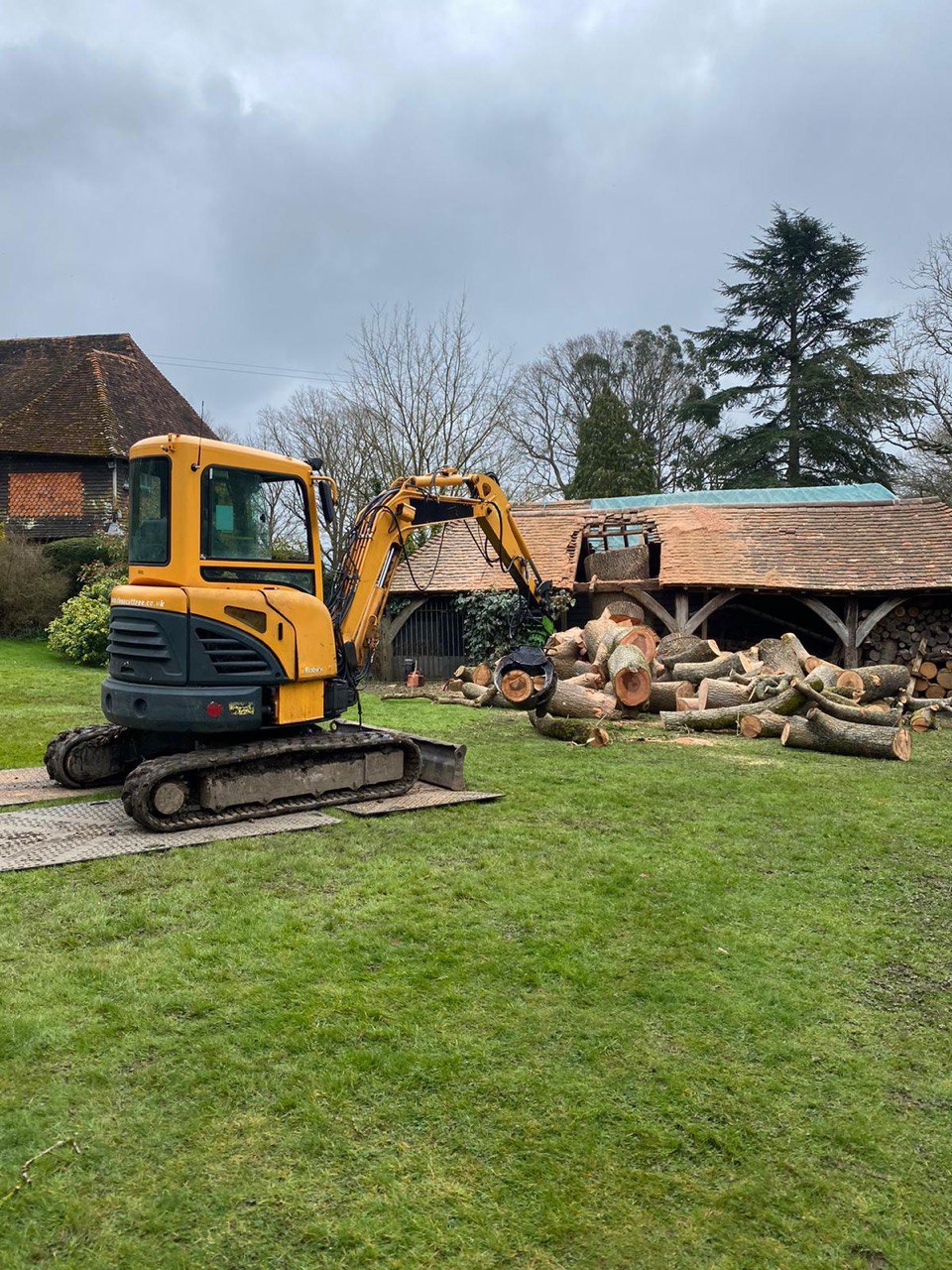
Tree felling involves managing considerable weight and unpredictable forces.
Branches may extend across surrounding areas, while the direction in which sections can be safely removed may be restricted by buildings, fences, planting and other features.
Where space is limited, the tree may need to be dismantled progressively rather than felled in one complete section.
Professional planning considers:
- The size and structure of the tree.
- Its condition and stability.
- Available working space.
- Surrounding property features.
- Suitable methods of dismantling.
- The sequence in which sections should be removed.
This controlled approach is especially important for mature trees in residential gardens.
Sectional Dismantling Can Help in Restricted Spaces
Not every tree can be removed using straightforward felling methods.
Where a tree is positioned within a confined garden, individual branches and sections of trunk can be carefully removed in a planned sequence.
This allows the tree to be dismantled progressively while maintaining greater control over each section.
The method used should always be based on the individual tree and its surroundings.
Avoid Waiting Until a Deteriorating Tree Becomes More Difficult to Manage
Where a tree has significant defects, delaying professional assessment can allow its condition to change further.
Branches may deteriorate, structural weaknesses can develop and the tree may become more complicated to manage.
Early assessment does not automatically mean the tree will be removed. Instead, it provides an opportunity to understand its condition while a wider range of management options may still be available.
Professional Tree Felling in Halesworth
At Halesworth Tree Surgeons, we provide professional tree surgery services throughout Halesworth, Suffolk. When there are concerns about the condition, stability or suitability of a tree, we can assess the situation and determine whether appropriate tree surgery can resolve the problem or whether felling should be considered.
Our approach focuses on understanding the individual tree before recommending work. Where removal is appropriate, careful planning and professional techniques allow the tree to be dealt with in a controlled manner suited to its location.
If a tree has become difficult to manage, experienced significant damage or is showing signs of deterioration, obtaining a professional assessment is the most useful first step.
Conclusion
Tree felling may become necessary when a tree has suffered serious structural damage, is dead or significantly declining, has developed stability concerns or has become unsuitable for its surroundings. However, size or overgrowth alone does not necessarily mean removal is required.
In many cases, professional pruning, crown reduction or other tree surgery can retain a tree while resolving the problem. The decision should therefore be based on the condition, structure and location of the individual tree rather than assumptions made from its appearance alone.
For property owners in Halesworth, Suffolk, Halesworth Tree Surgeons provides professional assessment, tree surgery and tree felling services. If you are concerned about an established tree and are unsure whether it can be managed or needs removing, contact our team to arrange an assessment and discuss the most appropriate way forward.
Call us on: 01508 505 537
Click here to find out more about Halesworth Tree Surgeons
Click here to complete our contact form and see how we can help with your tree needs.